Showing posts with label investment. Show all posts

Wednesday, September 2, 2015

Let's get America working!

The Teamsters want greater investment, better jobs.
The International Brotherhood of Teamsters is unveiling a new “Let’s Get America Working” campaign in advance of the 2016 election that will encourage both Democratic and Republican lawmakers to endorse a pro-worker platform.

At the center of the platform is the need for this country to invest in infrastructure, which in turn will create good jobs for everyday Americans. Working on transportation, energy and water projects will put thousands to work in construction jobs across the country. It will also improve roads, bridges, ports and other infrastructure, which in turn will help business and improve the U.S. economy.

The U.S. Labor Department’s own statistics support the Teamsters’ initiative. The median union worker earns more than $200 a week more than the median non-union worker. That’s an extra $10,000 a year that goes into the pockets of union workers. These jobs also offer health benefits and a pension.

Teamster President Jim Hoffa said:
While unemployment is down, the vast majority of jobs being created pay low wages. We can stop this trend and create good-paying union jobs if government invests in our nation’s workforce.
Infrastructure presents an opportunity to break the political gridlock. Congress in late July approved a three-month extension for spending on transportation projects that provides a temporary patch until the end of October for the continuing issue of road and rail funding. But it is not a real solution.

Since 2008, Congress has transferred more than $62 billion from the general fund to keep the Highway Trust Fund afloat, and it has been more than a decade since Congress has passed a highway bill more than two years in duration. Meanwhile, the transportation system continues to crumble and the safety of those who work and travel along the vast network of U.S. roads and rails is being jeopardized. Our nation’s failure to maintain and improve our infrastructure is costing Americans more and more.

There also is a significant need to move forward with a broader agenda that puts U.S. workers first. That means standing up against lousy trade deals like the Trans-Pacific Partnership that send American jobs overseas; protecting workers’ rights to form unions and collectively bargain; increasing affordability of college and vocational schools; and ensuring retirement and pension security for working families.

Lawmakers need to remember that dollars invested in education, job training and supporting retirement for those who worked hard all their lives helps not only individuals, but our society as a whole. These are promises each generation in this country has made to the next and we can’t forget it.

But if this nation is going to improve the lives of its citizens, Congress needs to advance bipartisan policies that will encourage good job growth. And it must put the current and future generations of workers in a position to succeed in the workforce by giving them the skills they need.

There was a time when all these issues weren’t partisan issues – they were American values, something everyone could support. But government is broken. Partisan bickering has replaced finding solutions. That’s why it’s essential for the Teamsters and like-minded allies all over the country to join together and push this message with lawmakers, colleagues, friends and family.

If elected officials from both parties want to rebuild and repair the trust between government and workers, they need to reinvest in people that have and can continue to make this country great. Better pay will lead to more spending and improve workers’ quality of life. That way everyone wins.

Let’s Get America Working! Now is the time to Build, Repair and Maintain America!

Friday, August 21, 2015

U.S. has the power, but needs dollars, to upgrade energy networks

Technology can be a magnificent thing. Nearly every home in America contains at least one device that has taken away chores that once occupied the time of family members. In a world of finite resources, however, technology can do something even more valuable -- make power usage more efficient.

Already, the use of smart meters -- which use broadband Internet networks -- can allow utilities and residents to monitor usage and even turn devices on-and-off remotely. It can save consumers money and curb usage. The meters are an essential part of a movement to create a smart power grid. There is much to be gained from moving forward with such a network, the Council on Foreign Relations stated:
A “smart grid” system can increase reliability and reduce power outages. Special meters on houses and businesses and sensors along transmission lines can constantly monitor demand and supply, while mailbox-sized devices known as "synchrophasors" measure the flow of electricity through the grid in real time, allowing operators to foresee and avoid disruptions. Smart appliances can "talk" to the grid and shift electricity use to off-peak times, which eases the burden on the grid, lowering prices and helping to avoid blackouts. Decentralized "microgrids" can be paired with new battery technology to allow for power to continue flowing to local communities even when severe weather or other outages afflict the broader power system.
But the U.S. lags substantially behind other nations in taking advantage of such tech marvels. The reason? Lack of infrastructure to bring such innovation nationwide.

It's a continuing saga for this country these days. Whether it's energy, transportation or water, a lack of investment in infrastructure is undoing America's greatness. And if the U.S. wants to remain a world leaders, that's got to change.

Investing in infrastructure will create good jobs for everyday Americans. Working on energy, transportation and water projects will put thousands to work in construction jobs across the country. It will also improve this nation's essential networks, which in turn will help business and improve the U.S. economy.

If Congress gets America working on the nation's 21st century needs, it will provide a brighter future for our families.

Tuesday, August 18, 2015

Water, water isn't everywhere -- and that's a problem

America finds itself now in the midst of the dog-days of August, a time when the heat and humidity tends to hit home a little harder as the summer season winds down. But it is also a time when many states and localities realize a lack of water is having profound effects on the way government operates and residents live their lives. 
These concerns are best known and most acute in much of California, but worries over water are not a problem for the Golden State alone. Aging and inferior water infrastructure is a major concern nationwide, and one that must be addressed by policymakers on all levels of government if the problem is going to be conquered.
That's why you have unions and business coming together demanding solutions in many cases, like the San Francisco Buildings and Construction Trades Council and the Silicon Valley Leadership Group. Leaders from both wrote in the San Francisco Chronicle late last month there is a dramatic need to modernize water systems. Both groups have endorsed California Gov. Jerry Brown's plan to fix them:
We rely on our state’s outdated water distribution system to deliver water to 25 million Californians and 3 million acres of farmland. But this 60-year-old water delivery system of aging dirt levees, aqueducts and pumps is outdated and at risk of collapse in the event of a major earthquake or flood. Fundamental structural problems would be even more pronounced during the extreme weather patterns — drought followed by a series of severe storms — that experts say will become the new norm because of climate change. 
California Water Fix will replace this aging infrastructure, better protect against disruptions to water supply during earthquakes, floods and natural disasters, and will improve the ability to move and store water during wet years. This project needs to move forward because it represents the most viable approach to securing our state’s water future. We strongly encourage Californians to join us by supporting this plan and commenting on the environmental impact report.
Others are also getting behind the effort to improve water infrastructure elsewhere. Whether its editorial boards in Texas or local government officials in Kansas, there is a profound understanding that more needs to be done. Water is a commodity we all need. It's necessary for life. 
These type of infrastructure issues must be moved to the front burner. Government at all levels needs to invest in people, and that in turn will help business. Let's get America working by improving systems we all need.

Monday, June 8, 2015

Jobs may be up, but workers are still struggling

There have been a lot of words written in the last few years about income inequality. That is a good thing -- it is a problem that is gripping many American families as they struggle to make ends meet despite holding down jobs.

Infrastructure investment creates good-paying jobs.
But what does the term really mean? At a time when more and more people are working, things should be looking up, right? Well, no. Just because there are more low-wage jobs doesn't mean more workers can support themselves. And a recent survey by the Federal Reserve Board really drove home that point.

While there are some signs that Americans feel a bit more confident about their family's economic well-being, it doesn't mean they are prepared for an emergency where they would need money in a hurry. The Federal Reserve notes:
The survey results reveal a lack of economic preparedness among many adults. Only 53 percent of respondents indicate that they could cover a hypothetical emergency expense costing $400 without selling something or borrowing money. Thirty-one percent of respondents report going without some form of medical care in the past year because they could not afford it.
And the news isn't much better when it comes to retirement. The study finds too many workers are not prepared for their golden years and many just plan to keep working:
Thirty-one percent of non-retirees have no retirement savings or pension, including nearly a quarter of those older than 45. Even among individuals who are saving, fewer than half of adults with self-directed retirement savings are mostly or very confident in their ability to make the right investment decisions when managing their retirement savings. 
Consistent with a lack of preparedness for retirement, 38 percent of non-retired respondents say that they either do not plan to retire or plan to keep working as long as possible. Among lower-income respondents, whose household income is less than $40,000 per year, 55 percent plan to keep working as long as possible or never plan to retire.
This nation needs an action plan to create middle-class jobs. It starts by investing in infrastructure that will create better roads, better transit and better energy networks. That would help not only workers but businesses as well. And it would boost the U.S. economy.

Workers shouldn't have to struggle to keep a roof over their heads. Elected officials need to value their contributions to society as much as they seem to value big business' campaign contributions. Now is the time to build, repair and maintain America!

Wednesday, May 20, 2015

America needs a long-term infrastructure solution

Congress has a work completion problem. The latest example came yesterday when the House approved a two-month extension of the Highway Trust Fund, which makes dollars available for transportation projects and maintenance. And the Senate is likely to follow suit by the end of the week.

More road construction would put Americans to work.
Stymied by gridlock, Capitol Hill lawmakers are ignoring the huge problems of U.S. infrastructure investment. Trillions are needed to improve roads, bridges, rail, mass transit, airports and ports in this country, but elected officials continually punt on the problem. Time is running short, however, as the Teamsters and others have repeatedly said.

The White House, frustrated by inaction, used yesterday's House action to call Congress on the mat. U.S. Transportation Secretary Anthony Foxx noted in a blog that Tuesday's vote was the 33rd short-term funding measure in the last six years. He said the nation is suffering because of it:
On the surface, funding transportation drop-by-drop might not seem like such a big problem. But it is, and the facts are unassailable. This era of short-term patches and chronic federal underinvestment has crippled America’s ability to build the transportation system we need.
Both parties admit there has been a policy failure. But as an article in The Atlantic points out, the problem comes down to how to pay for such investment going forward:
The most popular alternative at the moment is to use revenue generated by taxing repatriated earnings that U.S. companies now keep overseas. But there is disagreement over the details of that proposal, and Republicans believe it would only work if included in a broader tax-reform plan—an even heavier political lift. In fact, the reason Congress is reauthorizing the Highway Trust Fund for just two months is because lawmakers couldn’t agree on how to fund it for the remainder of the year, let alone for the rest of the decade. It has enough money to last through July, and Republicans are reluctant to simply transfer more money from the Treasury’s general fund, as they have done in the past. As a result, Congress probably will have to pass yet another extension this summer, which would be the third in the last year. A highway bill lasting for more than two years hasn’t passed on Capitol Hill in a decade. 
The stopgap funding is bad, advocates say, because the biggest infrastructure projects can takes years of planning, and states won’t start them without knowing how much money they’ll get from the federal government. Industry officials estimate that $2 billion in projects have already been pulled back so far this year because of the inaction in Washington. 
All of this is frankly unacceptable. Now should be the time to build, repair and maintain America! But many on Capitol Hill seems more than happy to ignore our infrastructure woes. That decision not only hurts those who commute to work and earn a living on the road, it also prevents putting people to work earning good middle-class wages in transportation construction.

Lawmakers must do a better job here. They were elected to get things done, but instead offer only platitudes on why they're not. Investing in infrastructure would help businesses and workers alike, and would boost the economy.

Come on, Congress! Let's get America working!

Wednesday, April 22, 2015

Abridged funding for infrastructure upgrades hurts all of us

Our nation's infrastructure is rickety, outdated and desperately needs upgrades. America's roads are in dire need of repair, costing the economy over $100 billion annually in lost fuel and time. The country's railroads are laughably obsolete and plans to upgrade them are pigeon-holed in a bureaucratic nightmare. Worst of all, the levees that surround our most vulnerable coastal regions are so decrepit that even the worst storm they've seen in 400 years should be viewed as better than a worst-case scenario, because the levees were weak enough to allow more damage. Why is this situation so severe?

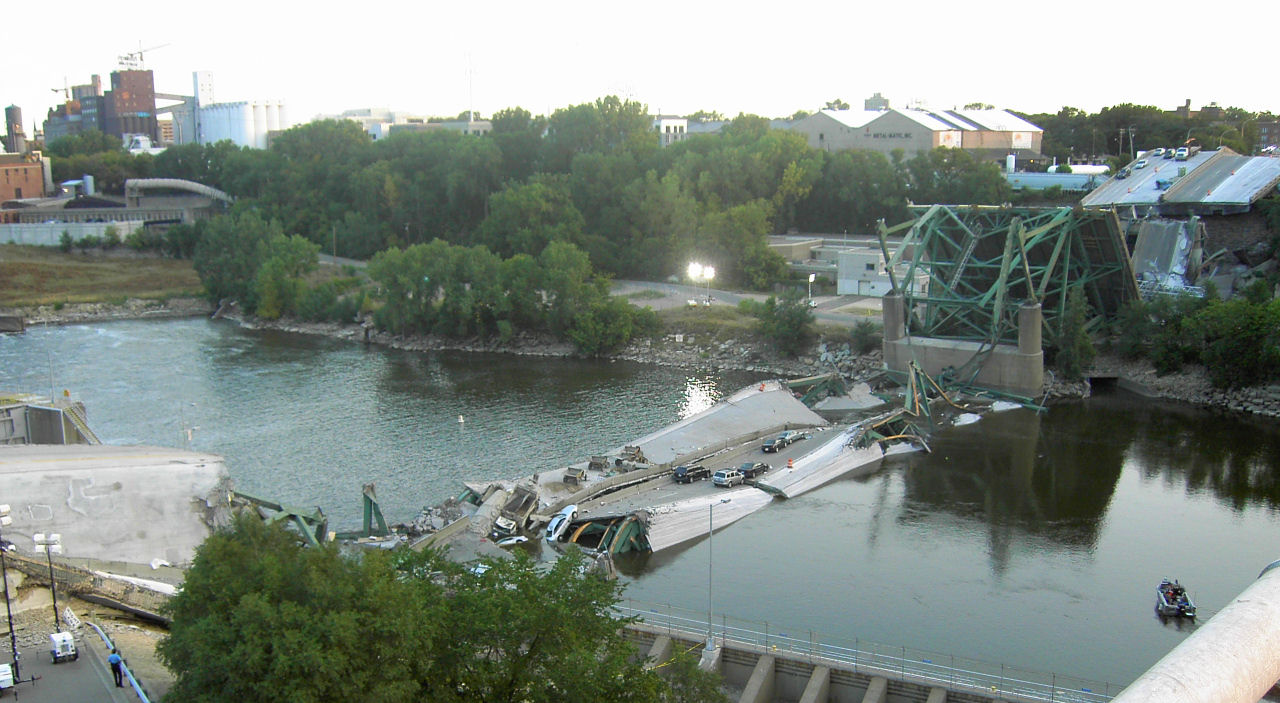
The I-35 Bridge in Minneapolis after its sudden collapse in 2007.
The most important reason for this is the policy surrounding infrastructure dollars is significantly outdated. The gas tax, the primary financial mechanism for this, is just over 18 cents per gallon and has not been raised since 1993. Fuel efficiency in vehicles has been rapidly increasing, thus fewer coins are going into the Department of Transportation's coffers since we are using far less gas than a few decades prior. The fiscal elephant on the road won't get any smaller though: it is estimated that our infrastructure needs an investment of $3.6 trillion dollars by 2020.

Another roadblock to solutions lies in how transportation funding is implemented. Recently, Congress has taken up the disgusting practice of funding the very basic functions of government at the last possible minute. This also applies to transportation funding, which is absolutely crippling for any positive momentum in terms of infrastructure. Real infrastructure improvements rely on long-term planning, timelines that stretch over multiple years, rather than just lurch from month to month. Without stable funding, it is impossible to plan projects that are sorely needed.

Potholes on a road in New Orleans.
Investment in this area of our society is a wonderful idea. The return on investment is massive and it's easy to see why -- safer roads will lower insurance costs for drivers, putting more money in their pockets and the regional and national economies. Likewise for individuals in areas prone to severe storms or flooding, strong levees mean their home insurance will be much less expensive. Regional rail systems save folks money on their commute and drives up property values, increasing property tax intake for the municipality of residence. It creates scores of American jobs. The list of economic benefits goes on and on.

Unions like the Teamsters take a great deal of pride in our country. We're proud to build what makes America work and we would be thrilled to get more workers on the job making our infrastructure the best in the world. It's time for a bipartisan solution to do so.

Thursday, November 7, 2013

Today's Teamster News 11.07.13

D.C. Taxi Operators Sue to Stop Fines, Towings  teamster.org   ...The Teamster-affiliated Washington, D.C. Taxi Operators Association has filed a lawsuit on behalf of the city’s more than 6,000 cab drivers, demanding that the District stop towing and impounding taxis and issuing fines to drivers who have been unable to install new dome lights or credit card machines...
Teamsters,Wegmans Meet With Federal Mediator  teamster.org   ...Teamsters Local 118 representatives and Wegmans resumed discussions Tuesday to resolve an ongoing contract dispute, this time joined by a mediator from the Federal Mediation and Conciliation Service (FMCS.) Previous efforts to engage FMCS were thwarted by a 16-day government shutdown...
eBay CEO Shares Lessons from His First Job as a Teamster  EcommerceBytes.com   ...eBay’s CEO John Donahoe talks about his job after high school working for his friend's father's beer distribution company as a Teamster, which taught him two great leadership lessons…
Planned layoffs jumped in October on drug, financial firm cutbacks  Los Angeles Times   ...Planned layoffs by U.S. employers jumped 13.5% last month, led by cutbacks at pharmaceutical and financial services firms, according to a report Wednesday...
Planned treaties cause pain for citizens; pleasure for corporations (opinion)  Lebanon Daily News   ...If you don't know what the TPP and the TTIP are, you can be forgiven. The governments and corporations involved don't want you to know because these international agreements they are negotiating are that good for them and that bad for you...
South Carolina Ports Launch Clean Trucks Program  Truckinginfo   ...The South Carolina Ports Authority has announced a new Clean Truck Certification Program to take effect on Jan. 1, 2014 that would require trucks serving the container terminals to have engines manufactured in 1994 or later...
One by One, States Are Pushing Bans on Sick Leave Legislation  Economic Policy Institute   ...Nearly 40 million Americans—almost 40 percent of the private-sector workforce—lack the right to even a single day of paid sick leave. These employees commonly go to work sick, or leave sick children home alone, out of fear of dismissal...
California Wal-Mart workers strike, following stunning Florida victory  The Salon   ...West Coast Wal-Mart workers walked off the job as the union-backed campaign says Florida strikers won major changes...
Next Time You're Tempted To Give A Bad Tip, Consider This  Huffington Post   ...The federal minimum wage for tipped workers is only $2.13 per hour...
The Biggest, Baddest Prison Profiteer of Them All  Huffington Post   ..."CCA" has become a dirty word. Because profiting off mass incarceration is a dirty business. When private prison company Corrections Corporation of America (CCA) squanders taxpayer money and runs facilities rife with human rights abuses, it's dragging its own name through the mud...
The super-rich no longer need a middle class  AlterNet   ...They now inhabit a privatized economy and have left us at the mercy of the market...
Inside the Psyche of the 1% -- Many Actually Believe Their Ideology of Greed Makes for a Better World  AlterNet   ...If the 1% are to develop the same level of understanding of others that the 99% has, they will need to walk in their shoes...
US Tax Policy In One Chart: Rising Individual Income Taxes; Falling Corporate Income Taxes  Zero Hedge   ...Because those record offshore (tax-haven arbitraged) corporate cash balances will not grow themselves, obviously...
Apple discloses government data requests -- what little it can  Los Angeles Times   ...The company released a report Tuesday that provided some general information about requests for information it receives from governments. But seeking full disclosure is an effort in futility...
Euro Crisis Takes Major Toll On Life Satisfaction  Reuters   ...Ordinary people's satisfaction with life has plunged in the euro zone countries worst hit by the financial crisis as faith in their governments' ability to ease the strain has shrunk according to a recent study...
Consumer watchdog targets debt collectors  Los Angeles Times...   The federal government's consumer financial watchdog plans to crack down on the nation's 4,500 debt collectors with new rules to rein in the companies' aggressive tactics...
It’s Time To Stop Starving U.S. Investment  teamster.org   ...An analysis of infrastructure spending by the Financial Times shows U.S. public investment is at its lowest level since World War II. Public sector investment is now just 3.6 percent of the nation’s gross domestic product, and austerity is hurting everything from building roads to investing in science and education...