Showing posts with label transportation. Show all posts

Tuesday, December 1, 2015

Cities take turn towards playground for rich

A generation ago, America's cities stood in a state of decay, largely abandoned by the wealthy for more suburban locales that sprawled across metropolitan areas that encircled urban centers.

Cities are increasingly home to only the wealthy.
But a funny thing happened in the last 20 years -- many children of those people who fled the city decided they wanted to live downtown, or at least closer to it. The result was places like New York City, Washington, Chicago and San Francisco became revitalized, but also insanely expensive. And many who had rode out the difficult times were now left to find someplace else to live.

Why is this? The population shift is a symptom of the times we live in. Many of those "making it" come from dual-income families that earn and therefore can spend more. But most everyday Americans don't fall into that category. In fact, for many of "the rest," pay has actually fallen in recent years.

A new National Bureau of Economic Research document details that shift. The more wealthy, increasingly white urban population can afford to buy homes close to their jobs. But most can't. As the Huffington Post details about the report:
This is primarily a story about time: Skilled workers, somewhat paradoxically, are working more than their unskilled counterparts. So gentrification becomes about moving to try to maximize the leisure time they have in the fraction of their lives that isn't spent sitting at a desk. 
But this is also a story about transportation and density, two things that American cities are notoriously poor at managing. If we built higher, more people could live closer to work for cheaper (empty foreign real estate purchases in New York aside). Similarly, if there were better public transportation from the city peripheries, there would be less need for the wealthy to crowd into the city centers.
The Teamsters agree that transportation plays a major role. That's why the union put forward it's "Let's Get America Working" platform earlier this year, and why a real investment in infrastructure is needed.

But with that said, neighborhoods are more vibrant when they are represented by a cross-section of this great country. People may not be able to live in their dream home, but they shouldn't be forced from the places they've called home for decades either. American cities should have a place for everyone to put down roots.

Wednesday, September 2, 2015

Let's get America working!

The Teamsters want greater investment, better jobs.
The International Brotherhood of Teamsters is unveiling a new “Let’s Get America Working” campaign in advance of the 2016 election that will encourage both Democratic and Republican lawmakers to endorse a pro-worker platform.

At the center of the platform is the need for this country to invest in infrastructure, which in turn will create good jobs for everyday Americans. Working on transportation, energy and water projects will put thousands to work in construction jobs across the country. It will also improve roads, bridges, ports and other infrastructure, which in turn will help business and improve the U.S. economy.

The U.S. Labor Department’s own statistics support the Teamsters’ initiative. The median union worker earns more than $200 a week more than the median non-union worker. That’s an extra $10,000 a year that goes into the pockets of union workers. These jobs also offer health benefits and a pension.

Teamster President Jim Hoffa said:
While unemployment is down, the vast majority of jobs being created pay low wages. We can stop this trend and create good-paying union jobs if government invests in our nation’s workforce.
Infrastructure presents an opportunity to break the political gridlock. Congress in late July approved a three-month extension for spending on transportation projects that provides a temporary patch until the end of October for the continuing issue of road and rail funding. But it is not a real solution.

Since 2008, Congress has transferred more than $62 billion from the general fund to keep the Highway Trust Fund afloat, and it has been more than a decade since Congress has passed a highway bill more than two years in duration. Meanwhile, the transportation system continues to crumble and the safety of those who work and travel along the vast network of U.S. roads and rails is being jeopardized. Our nation’s failure to maintain and improve our infrastructure is costing Americans more and more.

There also is a significant need to move forward with a broader agenda that puts U.S. workers first. That means standing up against lousy trade deals like the Trans-Pacific Partnership that send American jobs overseas; protecting workers’ rights to form unions and collectively bargain; increasing affordability of college and vocational schools; and ensuring retirement and pension security for working families.

Lawmakers need to remember that dollars invested in education, job training and supporting retirement for those who worked hard all their lives helps not only individuals, but our society as a whole. These are promises each generation in this country has made to the next and we can’t forget it.

But if this nation is going to improve the lives of its citizens, Congress needs to advance bipartisan policies that will encourage good job growth. And it must put the current and future generations of workers in a position to succeed in the workforce by giving them the skills they need.

There was a time when all these issues weren’t partisan issues – they were American values, something everyone could support. But government is broken. Partisan bickering has replaced finding solutions. That’s why it’s essential for the Teamsters and like-minded allies all over the country to join together and push this message with lawmakers, colleagues, friends and family.

If elected officials from both parties want to rebuild and repair the trust between government and workers, they need to reinvest in people that have and can continue to make this country great. Better pay will lead to more spending and improve workers’ quality of life. That way everyone wins.

Let’s Get America Working! Now is the time to Build, Repair and Maintain America!

Tuesday, August 11, 2015

Congress needs to prioritize infrastructure

The Teamsters have been (and will continue to be) leading advocates in the need for the U.S. to improve its transportation infrastructure. It starts with coming up with a long-term funding plan. But right now, Congress is failing in its duties.

More money is needed to repair rail and roads.
Right before lawmakers adjourned for the August recess, Capitol Hill whiffed on its latest attempt at a multi-year agreement. The House and Senate could not reach a deal on a possible six-year proposal, and instead chose yet another three-month fix that allows current work to continue through the end of October.

Teamsters General President Jim Hoffa said it is time for a united front on the issue that gets people working and improves road and rails for workers and travelers alike:
Yet again, too many lawmakers are not devoting the necessary effort to move a long-term transportation bill through Congress that will address this nation’s broad transportation infrastructure needs. Those on Capitol Hill must move past their ideological differences and find solutions that help the American people and the economy.
The problems this nation faces are truly serious. Whether it is a lack of positive train control for passenger rail or up-to-date bridges that won't crumble due to weather, the needs cannot be discounted. But elected officials don't seem to be taking the problem seriously.

Part of the problem could be that the same wealthy forces who stir the pot to make sure money is spent on items they value don't see it as a priority. As noted in the book "Injustice: While Social Inequality Still Persists," the rich in the U.S. are now more likely to live in cities, and thus don't value road spending. They also don't generally use mass transit. Meanwhile, infrastructure suffers.

Whatever the reason, it needs to stop. Investing in transportation would not only help people, it would help the economy. It would bring items to market quicker and more safely. It would boost American spending by creating new jobs. It's a win-win for everyone.

There are simply no more good excuses, When Congress returns to Washington after Labor Day, it's time to get it done. Let's get America working!

Wednesday, April 22, 2015

Abridged funding for infrastructure upgrades hurts all of us

Our nation's infrastructure is rickety, outdated and desperately needs upgrades. America's roads are in dire need of repair, costing the economy over $100 billion annually in lost fuel and time. The country's railroads are laughably obsolete and plans to upgrade them are pigeon-holed in a bureaucratic nightmare. Worst of all, the levees that surround our most vulnerable coastal regions are so decrepit that even the worst storm they've seen in 400 years should be viewed as better than a worst-case scenario, because the levees were weak enough to allow more damage. Why is this situation so severe?

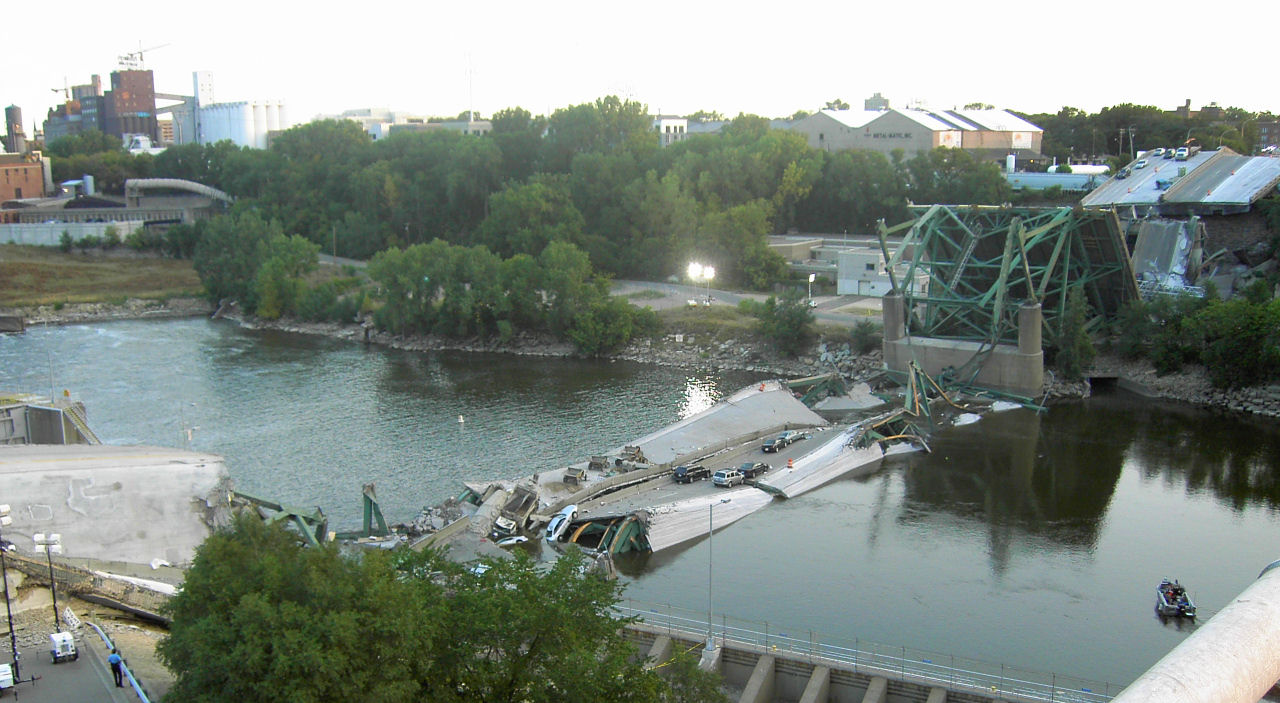
The I-35 Bridge in Minneapolis after its sudden collapse in 2007.
The most important reason for this is the policy surrounding infrastructure dollars is significantly outdated. The gas tax, the primary financial mechanism for this, is just over 18 cents per gallon and has not been raised since 1993. Fuel efficiency in vehicles has been rapidly increasing, thus fewer coins are going into the Department of Transportation's coffers since we are using far less gas than a few decades prior. The fiscal elephant on the road won't get any smaller though: it is estimated that our infrastructure needs an investment of $3.6 trillion dollars by 2020.

Another roadblock to solutions lies in how transportation funding is implemented. Recently, Congress has taken up the disgusting practice of funding the very basic functions of government at the last possible minute. This also applies to transportation funding, which is absolutely crippling for any positive momentum in terms of infrastructure. Real infrastructure improvements rely on long-term planning, timelines that stretch over multiple years, rather than just lurch from month to month. Without stable funding, it is impossible to plan projects that are sorely needed.

Potholes on a road in New Orleans.
Investment in this area of our society is a wonderful idea. The return on investment is massive and it's easy to see why -- safer roads will lower insurance costs for drivers, putting more money in their pockets and the regional and national economies. Likewise for individuals in areas prone to severe storms or flooding, strong levees mean their home insurance will be much less expensive. Regional rail systems save folks money on their commute and drives up property values, increasing property tax intake for the municipality of residence. It creates scores of American jobs. The list of economic benefits goes on and on.

Unions like the Teamsters take a great deal of pride in our country. We're proud to build what makes America work and we would be thrilled to get more workers on the job making our infrastructure the best in the world. It's time for a bipartisan solution to do so.