Showing posts with label Netroots Nation. Show all posts

Friday, July 24, 2015

Turning the tide on voter suppression

Voting rights is a key issue of our time, challenging democracy and the ability of the American people to participate in the electoral process as guaranteed under U.S. law.

N.C. residents took to the streets against voter suppression.
Many states in recent years have approved rules that tamp down on the ability of particularly minority voters to make it to the polls. An ongoing federal lawsuit challenging restrictive voter suppression rules approved by North Carolina lawmakers in 2013 stands as one of the leading examples of how legislatures across the country have tried to tip the scales toward a more corporate-friendly landscape.

As part of North Carolina NAACP v. McCrory, plaintiffs are rightfully questioning the trimming or eliminating measures that had been adopted over the previous 15 years in an effort to help boost electoral participation by minority and younger voters in North Carolina.

It appears even some of the proponents of those changes have had a change of heart in regards to the provisions they enacted two years ago. Gov. Pat McCrory (R.), for instance, recently signed into law changes that lessened the identification requirements to vote.

Efforts to defeat voter suppression or even make state laws less restrictive are actually on the rise, according to a panel that discussed the issue at the Netroots Nation conference in Phoenix last week. In fact, DeNora Getachew, campaign manager and legislative counsel for the Brennan Center's Democracy Program, said four times as many bills to expand voter rights were introduced in 2014 than to restrict them.
The trends we have seen ... is that the trend is actually in favor of increasing access to voting.
Participants from Nevada, Oregon and New Mexico discussed how building coalitions were essential to their efforts either to defeat stricter voting rules or to get measures passed that made it easier for state residents to cast a ballot. And in some instances, the results were truly monumental. In Oregon, for instance, the state earlier this year approved automatic voter registration.

The Teamsters have been active for years in registering union members to vote. That is the way this country makes sure the voices of all Americans are heard. Oregon is doing that. North Carolina isn't. Others need to follow the more inclusive model.

Monday, July 20, 2015

People need to preach importance of unions

PHOENIX -- Lawmakers and activists let the thousands of Netroots Nation conference attendees know last week that workers have the power. They just need to harness it.

Sen. Elizabeth Warren at Netroots conference.
In keynote addresses and smaller panel discussions, speakers shared stories about the successes and failures in trying to embolden a movement that puts the people above the powerful. They let it be known that it wouldn't be easy, but it is necessary to take this country back from corporate rule.

Sen. Elizabeth Warren (D-Mass.) brought conventioneers to their feet by repeatedly stating that issues such as income inequality, retirement security, financial reform and student loan debt are ranked as important ones by the public, even if they are too-often ignored by many on Capitol Hill.
"On these key economic issues, these economic issues that will shape the country, America is progressive. But insider Washington can't hear you; it turns its back. So it's on us to show what we believe in and fight for those values you believe in."
She also noted the importance that unions have in creating a solid middle class. Warren said the decline in income for hardworking Americans can be directly linked to undermining of the labor movement in the U.S.

The senator's thoughts echoed those of participants on a panel looking at how unions can provide solutions to the nation's current economic shortcomings. Several of them noted that a growth in union membership is essential to making a dent in income inequality.

Rep. Raul Grijalva (D-Ariz.) noted workers are currently pitted against a big business-dominated system that is doing everything it can to stop organizing nationwide.
"This has been a very deliberate, long-run effort of corporate America primarily and government to strip away the ability of unions to organize."
To change that, union advocates need to reframe the discussion, panelists said. That means explaining to Americans that a union contract is the best way to raise wages, ensure a secure retirement and receive paid leave for vacation as well as sick time.

Neera Tanden, president of the Center for American Progress, also said pro-worker activists need expand on how better-paid workers would help boost the U.S. economy overall.
"When wages are stagnant in this country, consumption drags and growth drags. It's not the most complicated argument in the world, but we need to make it over and over."

Friday, July 17, 2015

Workers' fight for justice takes on many forms

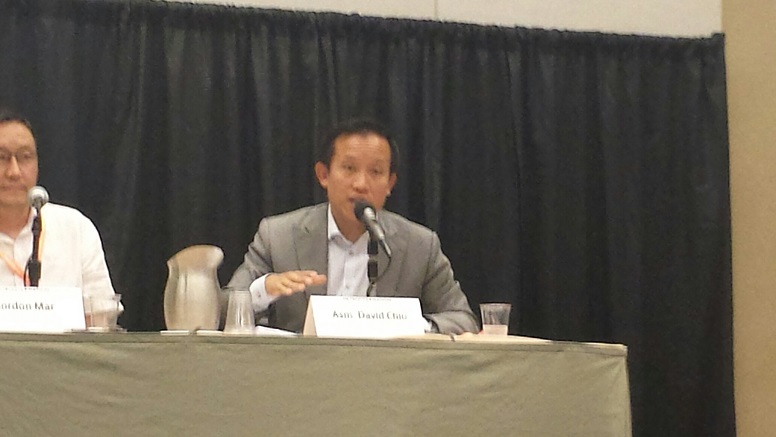
Calif. Assemblyman David Chiu
PHOENIX -- Workers are facing substantial challenges on the job. Whether it's low pay or work schedules that vary in hours per week and can change at almost a moment's notice, many are not earning enough to support themselves or their families. But they are not alone in trying to fight these issues.

Unions, worker allies and even some lawmakers said during the Netroots Nation conference here they are stepping up their efforts to challenge corporations that are trying to maximize their profits at the expense of their employees. And many involved in the movement told attendees they are beginning to win, and others can too.

California Assemblyman David Chiu helped lead the movement to force large retail companies in San Francisco last year to issue worker schedules two weeks in advance, and penalize those employers that change it. He said the debate is now moving forward elsewhere:
This is a conversation not just happening in San Francisco, but around the country. And the more it is, the greater the chance it will prevail. ... I have no doubt over the next few years we will prevail.
Part of the battle is trying to discuss the issue in a way that the public will understand. While the constant discussion of income inequality in the media and elsewhere over the past few years has raised awareness of the need for increasing the minimum wage, for instance, the discussion over the need for scheduling certainty still lags behind. It is part of an ongoing awareness campaign.

Nelini Stamp, co-director of Rise Up Georgia, said she originally began working in retail as a way to save up money for college. But the low wages and unpredictable schedules, mixed with the ever-increasing cost of higher education, has stalled that dream for now:
We want jobs. People want to work. But employers are taking it out of our hands. ... We believe we can push corporations to offer better schedules for their workers.
Of course, there are ways for workers to challenge these matters themselves. By organizing and joining a union like the Teamsters, workers can take these issues head on and win. It isn't always easy, but it can and does succeed.

Maria Neyoy, a bakery department employee for the El Super grocery chain in Arizona, is working to bring change that will help workers there. Since she got involved, the company has raised her salary by $4 an hour in hopes to get her to stop unionization efforts, but she said through an interpreter she won't until her coworkers can also receive a better salary:
This company ... does have the money to give us the raises we deserve. They are treating us like slaves. We are going to be out there until we get the contract we deserve.