Showing posts with label higher wages. Show all posts

Thursday, October 22, 2015

Ballot box provides push to raise wages

Just a couple of years ago, getting the minimum wage raised above $10 an hour seemed like a fantasy. But lawmakers in more and more cities are hearing the cry of workers who live there, and the movement for fair wages blossomed. But it's not done yet.

The Fairness Project, backed by unions, is pushing forward to help with 2016 ballot campaigns where voters themselves will get a chance to vote on whether to substantially raise the minimum wage more broadly. Initial efforts are being centered in California, Maine and Washington, D.C., but the group plans to get involved in other states as well.

As The Washington Post notes, the movement has history on its side:
According to the Ballot Initiative Strategy Center, minimum wage measures have been tried 20 times in 16 states since 1996, and all but two succeeded. The earlier victories came in waves, starting with the “living wage” movement in the 1990s. The campaigns even work in conservative states: in 2004, John Kerry lost Florida, but a minimum wage hike passed with 70 percent of the vote. 
Even though those measures may not have made it through state legislatures, in combination, they do seem to add momentum for minimum wage hikes on the federal level — Congress responded with legislation in 1997 after a spate of ballot initiatives, and again in 2007 and 2008. Sometimes, just the credible threat of a ballot initiative can spur state houses to action where previously they had no interest, although the final result may end up watered down. 
Most recently, in 2014, minimum wage measures passed in Arkansas, Alaska, Nebraska, and South Dakota. This latest wave is even more ambitious than the first and second, says Brian Kettenring, co-executive director of the Center for Popular Democracy — and it benefits from the narrative around inequality that arose during an economic recovery that delivered very little wage growth.
Of course, the movement continues elsewhere, and it should. In Syracuse, N.Y., for example, the mayor announced that the minimum wage for city employees would be raised to $15 an hour. And the Dallas City Council is currently debating whether to extend a minimum wage in excess of $10 an hour to contract workers in the city such as sanitation workers.

The Teamsters have continually stressed that raising wages increases respect and dignity for everyday Americans in the workplace. Higher wages is a central tenet of our new "Let's Get America Working" campaign because it improves lives for families and brings in more business. More money to spend means higher sales.

Joining a union is the best way to raise salaries. But for those without such an option, raising the minimum wage is a place to start. While too many lawmakers aren't acting on the issue, the public is. And the U.S. will benefit because of it.

Friday, July 17, 2015

Workers' fight for justice takes on many forms

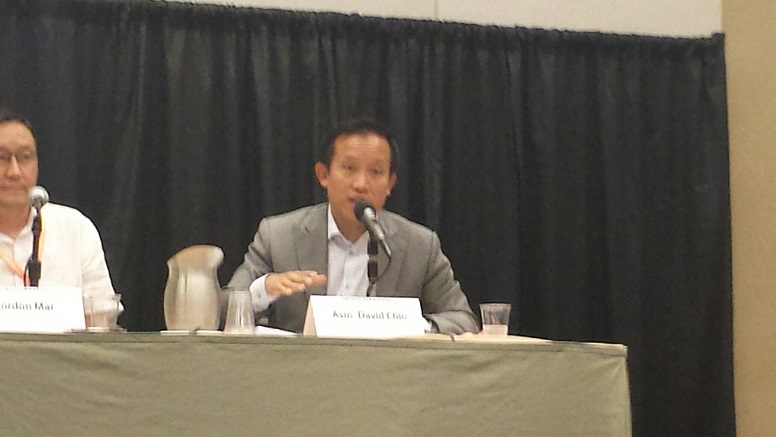
Calif. Assemblyman David Chiu
PHOENIX -- Workers are facing substantial challenges on the job. Whether it's low pay or work schedules that vary in hours per week and can change at almost a moment's notice, many are not earning enough to support themselves or their families. But they are not alone in trying to fight these issues.

Unions, worker allies and even some lawmakers said during the Netroots Nation conference here they are stepping up their efforts to challenge corporations that are trying to maximize their profits at the expense of their employees. And many involved in the movement told attendees they are beginning to win, and others can too.

California Assemblyman David Chiu helped lead the movement to force large retail companies in San Francisco last year to issue worker schedules two weeks in advance, and penalize those employers that change it. He said the debate is now moving forward elsewhere:
This is a conversation not just happening in San Francisco, but around the country. And the more it is, the greater the chance it will prevail. ... I have no doubt over the next few years we will prevail.
Part of the battle is trying to discuss the issue in a way that the public will understand. While the constant discussion of income inequality in the media and elsewhere over the past few years has raised awareness of the need for increasing the minimum wage, for instance, the discussion over the need for scheduling certainty still lags behind. It is part of an ongoing awareness campaign.

Nelini Stamp, co-director of Rise Up Georgia, said she originally began working in retail as a way to save up money for college. But the low wages and unpredictable schedules, mixed with the ever-increasing cost of higher education, has stalled that dream for now:
We want jobs. People want to work. But employers are taking it out of our hands. ... We believe we can push corporations to offer better schedules for their workers.
Of course, there are ways for workers to challenge these matters themselves. By organizing and joining a union like the Teamsters, workers can take these issues head on and win. It isn't always easy, but it can and does succeed.

Maria Neyoy, a bakery department employee for the El Super grocery chain in Arizona, is working to bring change that will help workers there. Since she got involved, the company has raised her salary by $4 an hour in hopes to get her to stop unionization efforts, but she said through an interpreter she won't until her coworkers can also receive a better salary:
This company ... does have the money to give us the raises we deserve. They are treating us like slaves. We are going to be out there until we get the contract we deserve.